

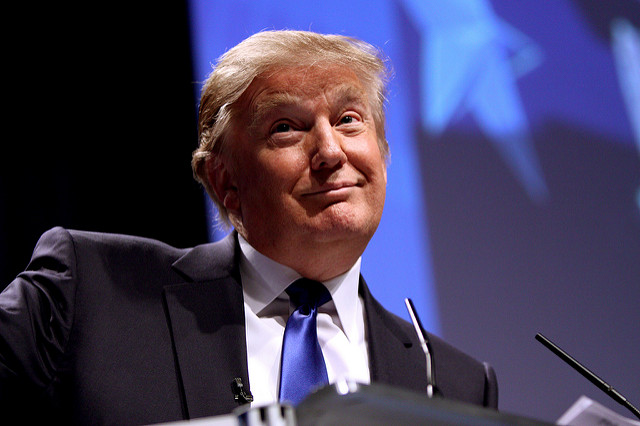
Courtesy Gage Skimmer
In an attempt to relaunch his campaign after a litany of gaffes and missteps, Trump gave a speech to the Detroit Economic Club. He used the event to outline his economic agenda, and he used the city as a backdrop for the so-called failure of an Obama-Clinton liberal agenda. “Detroit was once the economic envy of the world,” Trump stated. “But for many living in this city, that dream has long ago vanished.” To allay the concerns of voters, Trump claimed that his economic fix will bring trillions in wealth and raise household incomes for cities across America just like Detroit. Trump assailed his opponent Secretary Clinton for supporting “high taxes and radical regulation”, and he criticized her tenure as the junior Senator of New York as “failed leadership.” He stated that Clinton devastated the economy of upstate New York with a record of stagnated job growth and a 25 % reduction in manufacturing jobs. While his speech was filled with aspersions against his opponent, he also used the speech lay out his economic policies. He promised to reform the tax code, eliminate unnecessary and costly regulation, to overhaul trade policy, and set the course for energy independence.
The first section of his speech focused on tax reform. Trump promised to end the “Obama-Clinton agenda of tax, spend, and regulate”, and he called for a simplification of the tax code and a reduction of tax rates. He plans to overhaul the tax code by reducing the number of brackets from seven to three and propose a system of tax brackets of: 12,25, and 33 percent.He also claimed that his tax plan would leave lower income families with no tax burden at all. He also plans to reduce the cost of childcare by allowing parents to fully deduct the average cost of childcare from their taxes. Under Trump’s corporate tax plan, he intends that “no American company will pay more than 15% of their business income in taxes.” Trump also promised to end special interest tax loopholes like the Carried Interest Deduction that favor the wealthy. Trump outlined his plan to repatriate foreign funds in overseas bank accounts at a reduced ten percent rate.
Next, Trump laid out his plan to overhual the Federal Register which is presently eighty thousand pages long. “Upon taking office, I will issue a moratorium on new agency regulations,” said Trump. He modeled his plan after his running mate Governor Mike Pence issued a similar order in his state of Indiana. In addition to his regulatory moratorium, he also vowed to “cancel all illegal and overreaching executive orders.” He would the ask that each federal agency prepare a list of all regulations that are unnecessary, do not affect public safety, and needlessly kill jobs. Regulations submitted would then be summarily eliminated.
Trump then attacked Clinton for her previous support of free trade agreements like North American Free Trade Agreement, KORUS, the proposed Transpacific Partnership, and China’s entrance into the World Trade Organization. He used KORUS, the South Korean free trade agreement, as an example of how lopsided these kinds of agreements are. For example, he pointed out that the Obama administration predicted a surge in exports by the tune of $10 billion and subsequently resulted in a doubling of our trade deficit with that country. Trump pushed to revamp these agreements, and he promised to enforce trade rules with China and Mexico. While he remained adamant that America has been shafted by unfair trade rules, he cautioned that he is in favor of the free trade of goods and services across geographical borders. He told the audience that”isolation is not an option, only great and well-crafted trade deals are.”
The last part of his speech focused on energy reform. Trump assailed the “anti-energy” regulations of this administration. He assured energy sector employees that he would end the “war on coal.” He cited a partisan think tank, the Heritage Foundation, that stated that “by 2030, the Obama-Clinton energy restrictions will eliminate another half a million manufacturing jobs, reduce economic output by $2.5 trillion dollars, and reduce incomes by $7,000 dollars per person.” He also claimed that, according to the Institute for Energy Research, lifting Obama-era energy regulations would result in $100 billion boost to GDP, an addition of more than 500,000 jobs annually, and an increase in annual wages of over $30 billion.
Trump contends that by following his “America First” policy prescription that we will prosper from a pro-growth economy. However, there are many issues that remain unaddressed by Mr.Trump’s plan. Donald Trump fails to address substantive entitlement reform, job training, infrastructure investment, and work incentive programs in his plan for the economy. These are serious issues that voters from both sides of the aisle care deeply about. His tax plan lacks the substance that one would expect from an aspiring President. While he promises to eliminate the Carried Interest Deduction, he omits his plans for popular tax expenditures like the Earned Income Tax Credit and the Mortgage Interest Deduction. He spoke about energy reform while completely overlooking the renewable energy sector like wind, solar, and biofuels. He also promises sweeping tax cuts without considering its impact on the deficit.When I hear of Trump’s new ideas, I’m reminded of that ad from the 80’s, “Where’s the beef? “
 Jimmy Nickerson